An antique clock is both a mechanism and a designed object. Its case, dial and movement can tell different parts of its history. Explore documented examples of mantel, carriage, table and longcase clocks, and use their source records to build better questions about your own clock.
Read the parts separately
Look for an explicit description of the case, dial and movement. The same maker or date may not apply to all three. When a record mentions additions or later work, retain those qualifications rather than describing the whole clock with a single year.
Compare construction before decoration
Begin with the object’s form, dimensions and recorded materials. Then compare decoration. Two clocks with a similar decorative subject can differ in their construction, mechanism and history. A bronze-coloured surface alone does not establish that an entire case is bronze; use a documented material description and professional examination.
Preservation before operation
The Canadian Conservation Institute recommends a mechanical assessment before attempting to run an old clock. Completeness and condition matter, and some historic mechanisms should not be put back into use. Its guidance is a useful boundary: appearance and a ticking sound do not replace a condition assessment. Read the CCI guidance.
Explore the object studies

Clock with pedestal — Met 58.53a–c · ca. 1690
Study Met object 58.53a–c, dated ca. 1690: its recorded materials, maker attribution and dimensions, with source photographs and comparison notes.
Read the entry →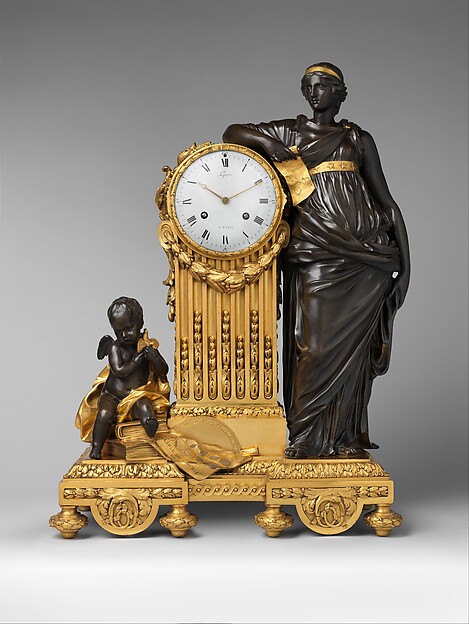
Mantel clock — Clockmaker: Jean-André Lepaute · ca. 1764–70
Study Met object 29.180.2, dated ca. 1764–70: its recorded materials, maker attribution and dimensions, with source photographs and comparison notes.
Read the entry →