This carriage clock in The Metropolitan Museum of Art is dated ca. 1890. The catalogue records Brass, glass, enamel and identifies the object as 1981.434. Its maker attribution is Boston Clock Company. Use the record as a documented point of comparison: the dates and attributions below belong to this collection object, and should not be transferred to a similar-looking timepiece without further evidence.
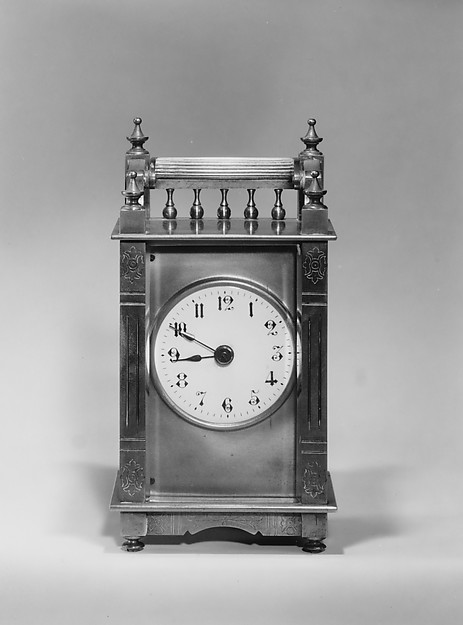
Catalogue facts
| Object | Carriage Clock |
|---|---|
| Date | ca. 1890 |
| Maker / contributors | Boston Clock Company |
| Materials | Brass, glass, enamel |
| Dimensions | 6 1/8 x 3 1/4 x 2 5/8 in. (15.6 x 8.3 x 6.7 cm) |
| Culture / place | American |
| Collection number | 1981.434 |
| Acquisition credit | Gift of Mr. and Mrs. H. Ochs, 1981 |
What to notice in this record
The date is qualified rather than exact. Keep that qualification in your research notes: it signals the level of precision supplied by the museum. Do not turn the beginning or end of a range into a documented manufacture year.
Enamel is included in the material description. When comparing another timepiece, note where enamel is visible and what the record actually specifies. Avoid assuming that every coloured surface uses the same technique.
Use it as a comparison
- Start with the complete form and the recorded dimensions, then compare individual features.
- Transcribe visible names and numbers on your own object exactly, recording their locations.
- Separate similarities from differences and mark information that cannot be checked in a photograph.
- Follow the museum link for additional views and any revisions before relying on the comparison.
Questions this entry can—and cannot—answer
Which object is being described?
The Met collection object 1981.434, catalogued as Carriage Clock. The image and facts on this page concern that object.
Does this identify a similar watch or clock?
No. It supplies a documented comparison. A proposed identification needs evidence from the object being examined.
Is a current value or working condition established?
Neither a current valuation nor a mechanical assessment is supplied by the metadata used for this entry. These points remain unassessed here.
What should I read next?
The antique-clock guide explains the broader method. For examination or service, consult an appropriate horology professional.
Source and image credit
The Metropolitan Museum of Art — 1981.434. Metadata consulted 15 October 2026. Gift of Mr. and Mrs. H. Ochs, 1981. Public-domain status recorded by The Met. Catalogue facts are separated above from our editorial comparison prompts. Read the editorial method.