Catégorie : Pocket Watches

  • Pocket-watch serial numbers: an evidence checklist

    A number on a pocket watch becomes useful only when you know where it appears and what system it belongs to. This checklist helps you prepare a clear identification request without confusing a museum number, case number and movement inscription.

    Record the location, not just the digits

    Start a table with four columns: location, exact transcription, photograph and interpretation. “Inside caseback” and “movement plate” are observations; “manufacture date” is an interpretation that needs a documented reference. Preserve leading zeros and punctuation.

    A museum number is a different kind of identifier

    The Metropolitan Museum of Art gives each collection object an accession number. For example, its Pierre Duhamel watch is recorded as 89.2.64. That identifies the museum object; it is not offered as a movement serial-number lookup. See the Duhamel watch record.

    Build a useful request

    1. Photograph the watch as a whole and every safely accessible inscription.
    2. Transcribe each mark, using a question mark for an uncertain character.
    3. Identify the source of any proposed date and the number it uses.
    4. Ask whether the case and movement evidence support the same interpretation.

    Do not force the case open or disassemble a movement to complete the table. Missing information can be added by an appropriate specialist. A short, accurate file is more useful than an elaborate description containing assumed facts.

    Keep conclusions proportional

    Even a successful date lookup concerns the number and component covered by that reference. It does not automatically establish the date, originality or condition of the complete watch. Add those as separate questions in your notes.

    Frequently asked questions

    Can I use a museum accession number to date my watch?

    No. It identifies the collection object, not your watch.

    Should I combine all numbers into one field?

    No. Keep their locations and photographs separate.

    What if a digit is unclear?

    Mark it as uncertain; do not silently choose a digit to fit a result.

    Does a date lookup prove authenticity?

    No. Continue with the pocket-watch evidence guide and request examination when needed.
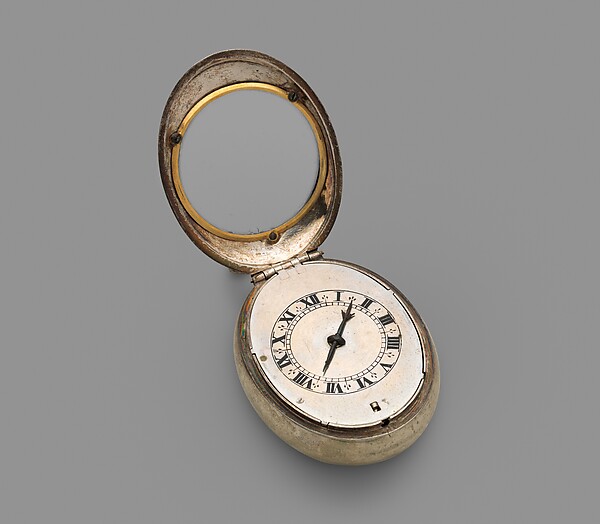
  • Watch — Watchmaker: Edward East · ca. 1640

    This watch in The Metropolitan Museum of Art is dated ca. 1640. The catalogue records Outer and inner cases: silver, with a plain silver dial; movement: gilded brass, silver, and steel, partly blued and identifies the object as 17.190.1468a, b. Its maker attribution is Watchmaker: Edward East. Use the record as a documented point of comparison: the dates and attributions below belong to this collection object, and should not be transferred to a similar-looking timepiece without further evidence.

    Watch, ca. 1640, Met 17.190.1468a, b
    Watch · ca. 1640 · The Metropolitan Museum of Art, 17.190.1468a, b. Public domain. View the source record.

    Catalogue facts

    Object Watch
    Date ca. 1640
    Maker / contributors Watchmaker: Edward East
    Materials Outer and inner cases: silver, with a plain silver dial; movement: gilded brass, silver, and steel, partly blued
    Dimensions Overall: 1 3/4 × 1 1/2 in. (4.4 × 3.8 cm)
    Culture / place Not specified in this record
    Collection number 17.190.1468a, b
    Acquisition credit Gift of J. Pierpont Morgan, 1917

    What to notice in this record

    The date is qualified rather than exact. Keep that qualification in your research notes: it signals the level of precision supplied by the museum. Do not turn the beginning or end of a range into a documented manufacture year.

    The material description includes gilding. Keep the distinction between a surface finish and the material beneath it. A gold-coloured appearance is not a substitute for the source’s specific material description.

    Use it as a comparison

    1. Start with the complete form and the recorded dimensions, then compare individual features.
    2. Transcribe visible names and numbers on your own object exactly, recording their locations.
    3. Separate similarities from differences and mark information that cannot be checked in a photograph.
    4. Follow the museum link for additional views and any revisions before relying on the comparison.

    Questions this entry can—and cannot—answer

    Which object is being described?

    The Met collection object 17.190.1468a, b, catalogued as Watch. The image and facts on this page concern that object.

    Does this identify a similar watch or clock?

    No. It supplies a documented comparison. A proposed identification needs evidence from the object being examined.

    Is a current value or working condition established?

    Neither a current valuation nor a mechanical assessment is supplied by the metadata used for this entry. These points remain unassessed here.

    What should I read next?

    The pocket-watch evidence guide explains the broader method. For examination or service, consult an appropriate horology professional.

    Source and image credit

    The Metropolitan Museum of Art — 17.190.1468a, b. Metadata consulted 15 October 2026. Gift of J. Pierpont Morgan, 1917. Public-domain status recorded by The Met. Catalogue facts are separated above from our editorial comparison prompts. Read the editorial method.